Screening exception calls
Most applicants are an easy yes or an easy no. The ones in between land on a manager's desk, get decided between two other things, and leave no record of why.
Beverage alcohol distribution
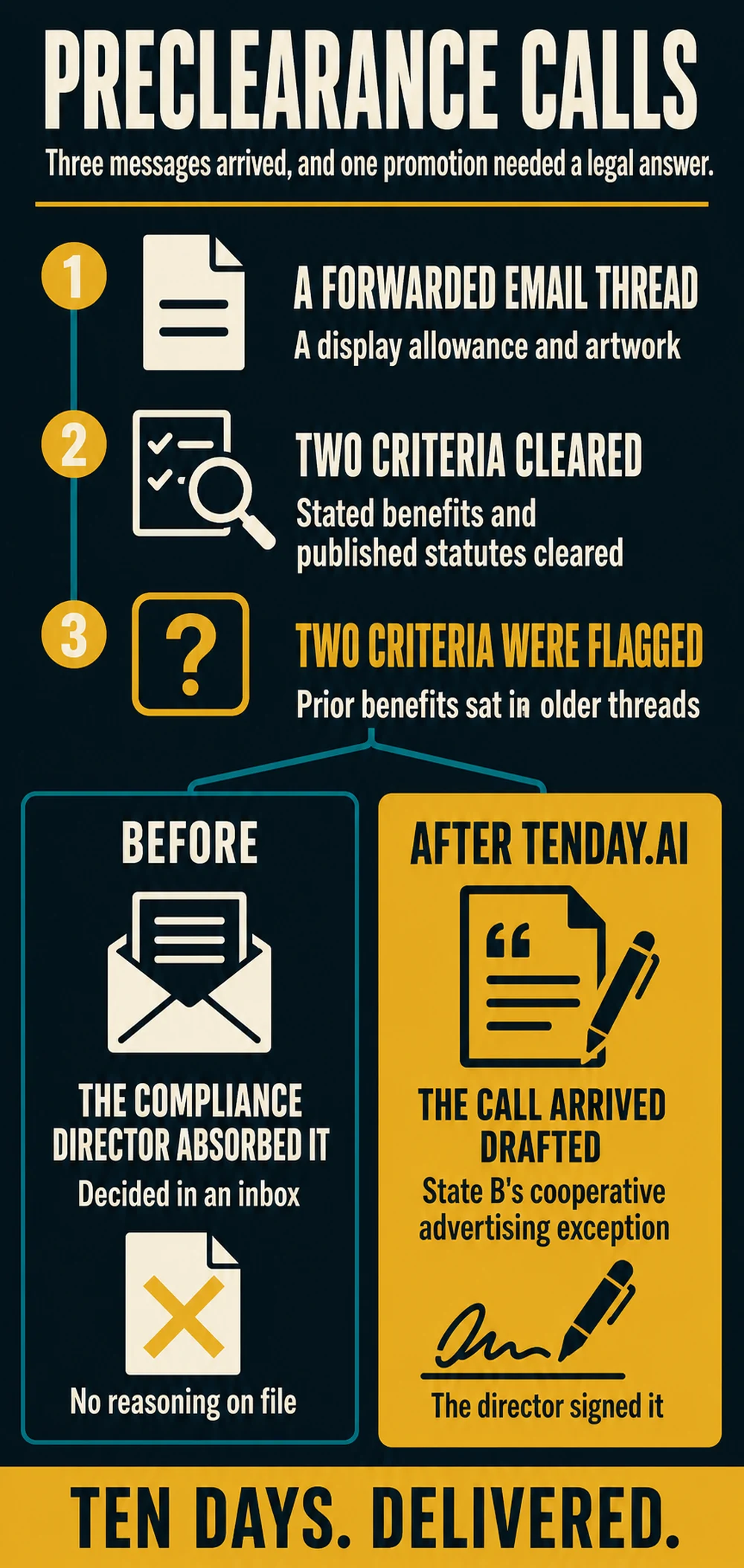
A rep forwards an email thread with a retailer. It carries a proposed display allowance and a file for the point-of-sale sign. Before anyone can say whether it is legal, the compliance director has to reconstruct what was agreed. Three messages, and someone's memory of a phone call.
The gap
The queue drafts, cites and conditions. It does not approve. Nothing reaches the retailer and no record is filed until the compliance director signs. An override is kept beside the draft it replaced. Without that signature, what is lost is what the current process already loses: the reasoning. A decision made in an inbox against a launch date leaves nothing behind. Nothing for the state regulator, or the auditor. Nothing for the person asked six months later why that promotion cleared and a similar one did not.
Where the tools stop
Deciding whether a benefit to a retailer fits a statutory exception is a fact-specific judgment. It is also a liability nobody wants to own by default. So the market has built everything around that judgment and left the judgment alone. The exposure lands on one reviewer, often sharing the job with another title. That reviewer works from memory and an email thread, against a deadline the retailer has already been told about.
Manages licensing, product and label registration, real-time shipping compliance, and excise and sales tax reporting. It does not evaluate a proposed retailer promotion at all.
Checks whether finished creative conforms to pre-approved brand assets and disclaimer language. A display sign can pass that check while the arrangement behind it still breaks a tied-house exception, because Palette never looks at the arrangement.
Tracks trade spend, pricing and depletion allowances. It treats the promotion as a financial governance problem, not a legal one.
Creative operations routing that gets a submission in front of legal faster and can flag it for review. Routing is not ruling.
Distributor ERP that administers promotions operationally, without making a trade-practice determination on any of them.
Operationalizes regulated e-commerce sales. That is a different problem from clearing a promotion before it runs.
What changes
We build a preclearance queue, scoped to one promotion family in the two states carrying the most volume. It reads the submitted request and its attachments. It identifies the retailer and the specific thing of value being offered. Then it checks that against the federal tied-house framework and both states' trade-practice rules for that promotion type. The output is one of four calls: approve, approve with conditions, reject, or request more facts. Each draft cites the governing provision by section, lists the conditions or missing facts, and carries a confidence score. The compliance director signs or overrides.
Drafted recommendation, awaiting signature
What the engagement needs
Three inputs. The promotion request emails and attachments, as they already flow to compliance. The current house policy for that promotion family. The governing statutes and regulations for the two named states. No regulated data category is involved. The compliance director or general counsel reads and signs every draft. Correcting the citations in the first cycles is how the queue earns the next one. On day eleven it covers that one promotion family in those two states. Everything outside that scope stays on the old process until the buyer decides to extend it.
The whole thing
Honest limits
A one- or two-person compliance function reviewing a manageable weekly volume may find the reconstruction tolerable, not painful. Two questions settle it before anyone builds. How many promotions move through the queue in a normal month. And whether the reviewer would sign a drafted call in minutes, or still feel obliged to re-derive the whole analysis. If it is the second, the queue has moved the work without removing it.
The competitor closest to closing this gap is an enterprise legal-AI platform: Onit, Ironclad, Harvey, Spellbook or Robin AI. The move would be deciding that alcohol trade practice is worth a vertical template. That template would sit inside an existing contract review or governance product. Nothing rules that out.
The vendor descriptions above come from published product material, not hands-on trials. They record what each product says it does.
More use cases
Most applicants are an easy yes or an easy no. The ones in between land on a manager's desk, get decided between two other things, and leave no record of why.
A background check comes back flagged on a Tuesday afternoon. A hiring manager between shifts decides whether a five-year-old charge bears on a warehouse role. The manager writes two sentences and moves the file.