Screening exception calls
Most applicants are an easy yes or an easy no. The ones in between land on a manager's desk, get decided between two other things, and leave no record of why.
Multi-location hiring
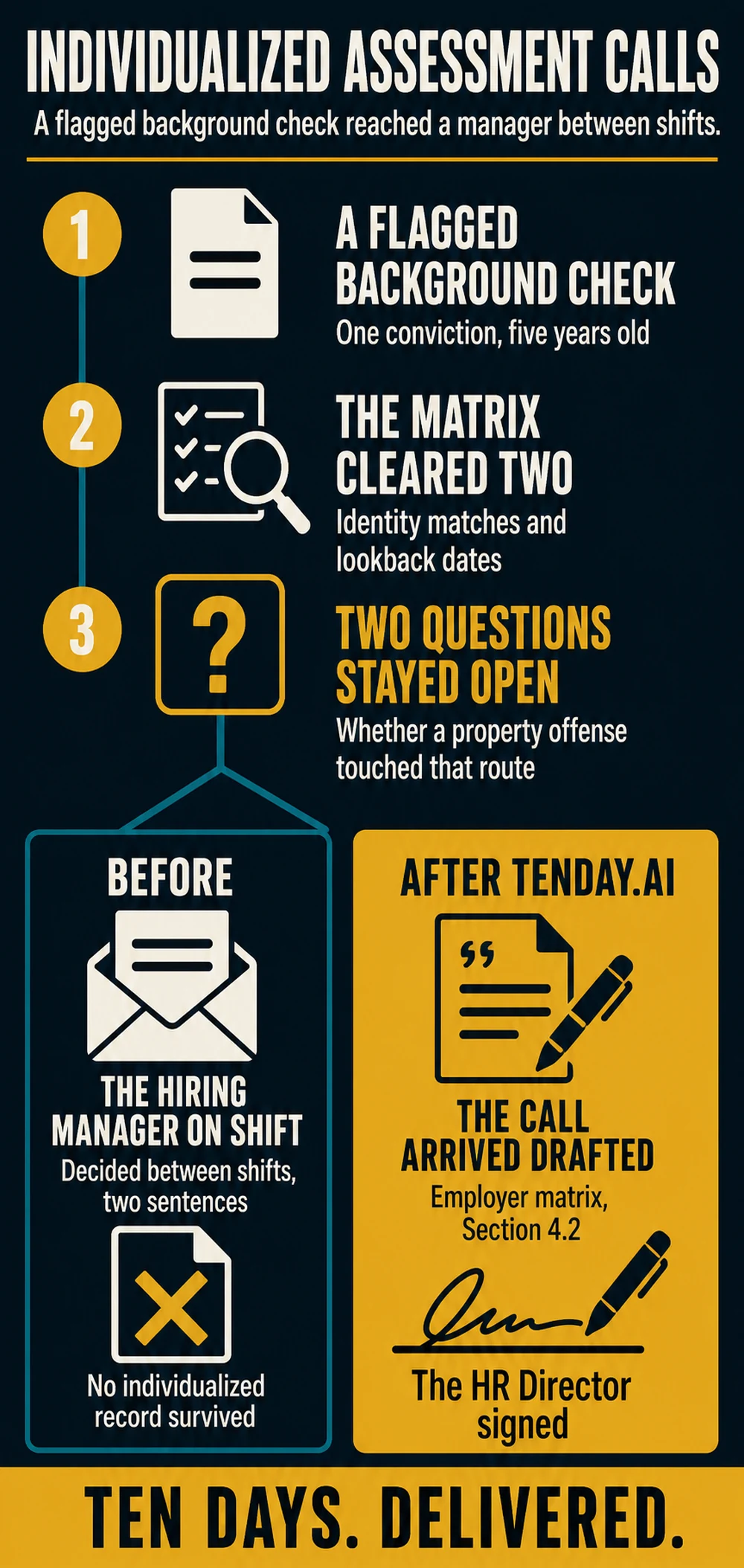
A background check comes back flagged on a Tuesday afternoon. A hiring manager between shifts decides whether a five-year-old charge bears on a warehouse role. The manager writes two sentences and moves the file.
The gap
The manager on shift makes it, writes two sentences, and returns to the floor. At the next location that week, a similar flag on a similar role gets a form rejection. No individualized notes at all. Neither manager did anything wrong. Six months later an EEOC charge or adverse-action demand letter asks why two similar offenses got different outcomes. The answer is whatever those two sentences say.
Where the tools stop
The rules engine sorts a report against criteria the employer set. The written assessment is the next step. It states why this offense is job-related and consistent with business necessity. For this role, at this distance in time. Vendors decline that step. Owning the reasoning means owning the FCRA and EEOC exposure attached to it. Several say so in their own product material.
Sells adjudication tooling around a flagged report: configurable rules, note fields, and adverse-action workflows that keep the process tracked and timed.
Runs the same path with configurable criteria and templated adverse-action letters, so the sequence is consistent even when the reasoning is not.
Its Client Matrix Application applies an employer's own pre-set eligibility criteria per job, so a flag arrives already sorted against the written policy.
Centralizes tracking of how each report compares against pre-established hiring criteria, which puts one record in one place across every location.
States the boundary outright: decisions are always made by its clients, real people, and it does not use AI to assign pass or fail.
Describes its Insight+ engine as a rule-based filter to configure rather than AI. Its Ava assistant does gather part of the individualized-assessment material.
What changes
An agent reads the flagged report through the CRA's own API. It drafts the individualized assessment against the employer's adjudication matrix: offense, time elapsed, job-relatedness, mitigating evidence. It cites the clause it relied on and scores its own confidence. Clean matches come back as a draft to check. Anything ambiguous is queued. The HR Director reads it, agrees or overrides, and signs every letter.
Drafted recommendation, awaiting signature
What the engagement needs
Three things. API access to the CRA's flagged-report feed. The written adjudication matrix. The signer's time to read queued cases. The matrix usually sits in an HR handbook or a compliance binder already. If it does not exist yet, writing one is part of the work. The agent handles regulated background-check data and criminal history. It drafts, cites and queues. It does not send, file or decide. The HR Director signs every letter.
The whole thing
Honest limits
A liability-sensitive buyer may want no agent near reasoning that could land in a legal defense file. Drafting behind a mandatory signature still counts. Three things settle whether this is worth building. Whether a written matrix exists to ground the agent against. How many flagged reports a week cross the signer's desk. Whether a charge, demand letter or audit finding has already put a number on inconsistency.
Bchex already gathers part of the individualized assessment through its Ava assistant. A CRA could ship this into its existing matrix product. The gap between today's tools and this agent is shorter here than on the other pages.
The vendor descriptions above come from published product material, not from hands-on trials of each system.
More use cases
Most applicants are an easy yes or an easy no. The ones in between land on a manager's desk, get decided between two other things, and leave no record of why.
A rep forwards an email thread with a retailer. It carries a proposed display allowance and a file for the point-of-sale sign. Before anyone can say whether it is legal, the compliance director has to reconstruct what was agreed. Three messages, and someone's memory of a phone call.