Self-directed IRA custody

FMV sufficiency calls

Three weeks from the Form 5498 deadline, an analyst works down a stack of valuation files. In March it was a trickle. An appraisal, a K-1, a sponsor letter, a purchase agreement nobody has updated in three years.

Who has itMid-size specialty self-directed IRA custodians
Whose call it isThe compliance officer
BuildTen business days
You keepThe build, its source, and the encoded policy

The gap

Source, date and method usually settle the file. Independence and coverage do not.

Independent appraisal Dated, signed, a license number on it, no tie to the sponsor. Clean, sign it.Clears
Effective date Inside the lookback window the acceptance policy sets for the reporting year.Clears
Valuator independence A valuation letter from the same sponsor whose fund is being valued. Explaining why that fails takes longer than approving the clean one did.Flagged
Assets the policy does not cover A non-standard private placement, or a thinly documented purchase agreement that sits outside the written classes.Flagged
Needs a person.

The file goes to the analyst. The analyst decides whether the evidence meets a reasonable basis or returns it to the account owner. The decision is usually right. The reason for it is almost never written down. A file questioned six months later has a signature on it and nothing behind it.

Where the tools stop

Every product in this space reads the document. None of them will make the call.

Making the call means owning part of the liability when it is wrong. The custodian's published position, repeated across the industry, is neutrality. It does not value assets. The account owner supplies the figure. Nobody outside the custodian is positioned to hold that liability. So the products stop one step short and hand back clean data.

Reggora

Runs AI-driven review of mortgage appraisals for residential lenders, auto-approving or flagging against compliance rules and investor overlays, with a warranty behind what it passes. It shows an agent can read an appraisal and rule on it, for a different buyer, a different asset class and a different valuation instrument.

AltExchange, now part of iCapital

Extracts and structures alternative-asset data, capital calls, valuations and statements, for RIAs and LPs. That is aggregation: it delivers clean data and stops before the sufficiency question a custodian has to answer.

What changes

The same file arrives with the deficiency already named

The agent reads every FMV submission as it arrives, by file or by email. That covers appraisals, K-1s, sponsor valuations and purchase agreements. It checks source, date, methodology and valuator independence against the written acceptance policy. It then drafts accept or insufficient, cites the specific deficiency, and attaches a confidence score. The compliance officer who has always signed the file still signs it.

Drafted recommendation, awaiting signature

Asset
LLC membership interest, non-traded fund. Submitted as a sponsor-issued valuation letter dated eleven months prior, with no stated methodology.
Call
Insufficient. The valuator is an affiliate of the fund sponsor.
Criterion
Acceptance policy: the valuator must be independent of any party with a financial interest in the outcome.
Confidence 88%
Escalated for sign-off The asset sits outside the classes the policy covers cleanly. It queues for the compliance officer with the read attached. The read is a starting point, not a verdict.
What the engagement needs

The engagement needs the policy on paper, not in an analyst's head

The engagement needs three things. The written acceptance policy. A sample of past accepted and rejected FMV files to calibrate against. File or email access to the current cycle's submissions. The compliance officer signs every queued call and every override. Nothing is accepted or sent back without that signature.

The whole thing

One case, before and after.

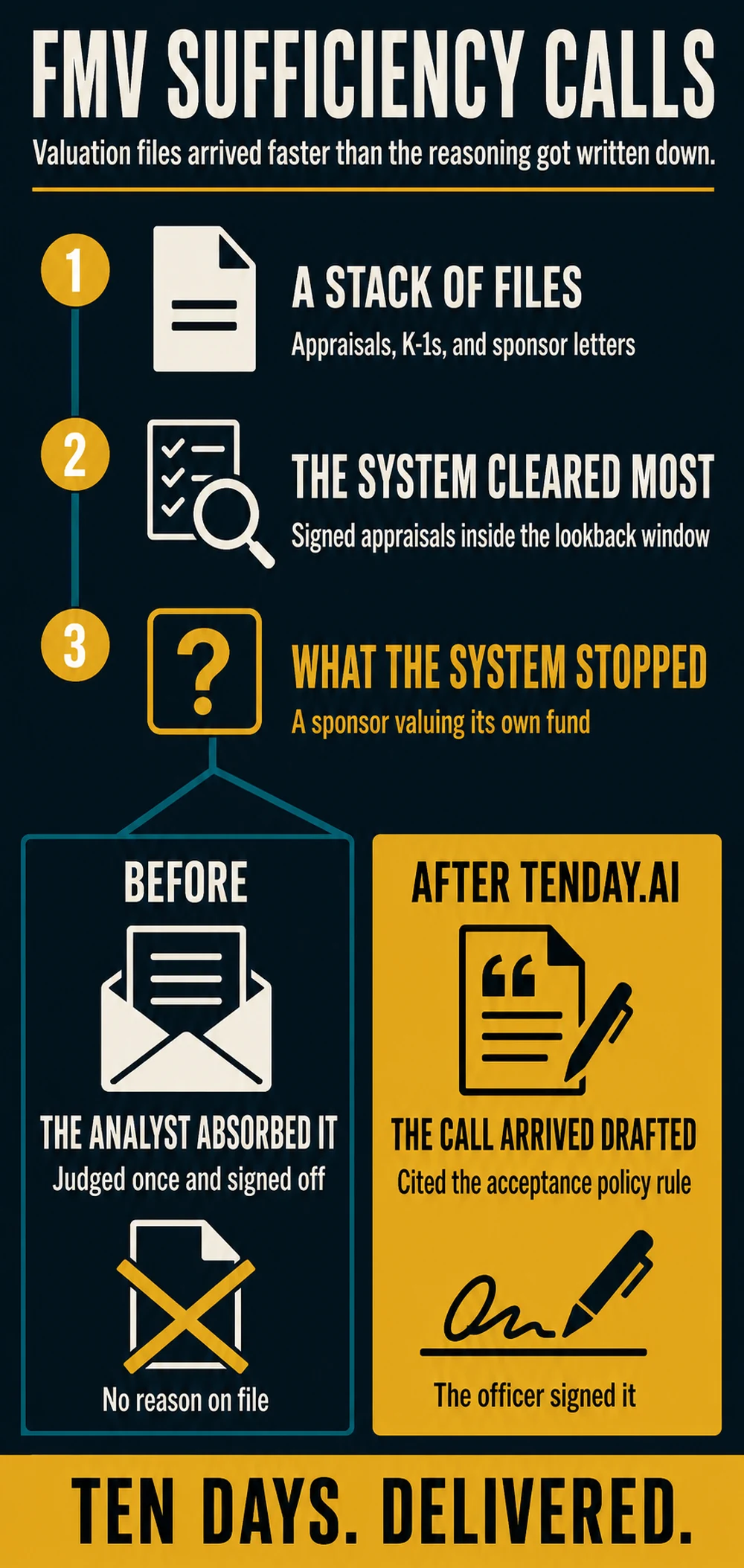
three steps, then a fork. one, a stack of files: appraisals, k-1s, and sponsor letters. two, the system cleared most: signed appraisals inside the lookback window. three, what the system stopped: a sponsor valuing its own fund. before, the analyst absorbed it, judged once and signed off, with no reason on file. after tenday.ai, the call arrived drafted, cited the acceptance policy rule, and the officer signed it. ten days, delivered.
The same case, before and after. Tap to view full size.

Honest limits

The strongest case against building this is feasibility

Feasibility is the weak point and the honest risk. Encoding the acceptance policy in ten days gets harder if it is underspecified. It gets harder still if it lives as tribal knowledge in analysts' heads. The confidence score is only as good as the labeled accept and reject history available to calibrate it. If that history is not in usable form, ten days may not be enough to gather it. A buyer conversation has to settle both questions before day one.

Reggora is the competitor closest to closing this gap. It has already proven appraisal review at a lender. A move into alternative-asset compliance review is not a stretch of what it is built to do.

The vendor descriptions here come from published material, not hands-on trials.

Show us the work

More use cases

Three more credit and lending calls.

Community banks and credit unions small enough that one or two analysts carry every commercial renewal

Renewal exception calls

A borrower's renewal folder arrives as two years of tax returns, a bookkeeper's statements and a scanned rent roll. No two folders arrive in the same shape. The credit analyst retypes all of it by hand before any credit thinking starts.

Read the full write-up

Regional banks and independent finance companies running dealer floor-plan lines in auto, RV or marine, from a handful of dealers to a few hundred.

Out-of-trust calls

A field auditor walks a dealer lot on a fixed cycle. The auditor photographs units and checks serials against what the dealer still owes. Most days it is clean. Then a unit is not where the schedule says it should be. The dealer's explanation sounds plausible.

Read the full write-up

Regional surety and insurance companies writing contract surety bonds

Claim validity calls

A regional downturn does not send one default notice. It sends a run of them inside the same few weeks. Every one waits for an examiner to read the bond. Until then, nobody knows which are fast denies and which are full investigations.

Read the full write-up