Contract manufacturing

MRB dispositions

A shaft comes off the mill with a critical diameter outside print. The part gets tagged. The work order stops. The call that unsticks it needs quality, engineering and operations free at the same time.

Who has itAS9100 and ISO 13485 contract manufacturers, 10 to 40 people: machine shops, sheet metal shops, injection molders
Whose call it isThe quality engineer
BuildTen business days
You keepThe build and its source

The gap

Most nonconformances are settled by the print. The few that are not hold up the rest

Measured deviation against the callout The inspection value and the feature tolerance sit in documents the shop already has. Putting them side by side is arithmetic, and arithmetic does not need a meeting.Clears
Bonus tolerance at MMC A positional callout at maximum material condition earns extra allowance as the feature departs from MMC. The drawing note says how much, and the note is on the drawing.Clears
Fit, form or function Whether a part that misses the number still works in the assembly is a judgment about the customer's product, not a lookup. Nothing on the drawing settles it.Flagged
Customer acceptance language A print tolerance and a customer's deviation clause do not always agree. When the PO is stricter than the drawing, the drawing is not the governing document.Flagged
Needs the board.

Below the confidence threshold the shop sets, or above the part value limit the quality manager sets, the agent stops. It queues the part for the MRB rather than drafting something for a rubber stamp. What it read stays attached: the measurement, the callout, the customer clause, and the reason it would not commit. The board still meets. It starts from a written position rather than a stack of PDFs.

Where the tools stop

Every QMS on the market routes the NCR. None will decide it

Intake, routing, approval signatures, a record the auditor will accept: all solved. None of it is where the part is stuck. The disposition is the piece nobody sells, because the disposition is a liability. A platform selling to every shop in the industry has no reason to own one shop's fit, form and function judgment. The documentation says so plainly. The MRB is the authority, and the software waits for its answer.

QT9

Runs the nonconformance workflow end to end: intake, routing, sign off and retention. It carries the record of the disposition, not the reasoning behind it.

MasterControl

Document control and quality event management built for regulated manufacturers. It enforces who has to approve a disposition and keeps the audit trail proving they did.

Arena

Ties quality records to the part, the BOM and the revision, so the NCR is attached to the right drawing version. It routes the review; the review still has to happen.

Intelex

Enterprise quality and EHS workflow with strong reporting across sites. The nonconformance module tracks the queue and its aging, which is how the shop knows how long parts have been waiting.

Tulip

The closest thing on the market to this call. Its AI Automations for Defect Management lets a shop configure a prompt that sorts a defect record into scrap, use as is, rework or question. By its own description the sort runs on descriptive keywords in the record, not on a comparison between the measured deviation and the governing tolerance.

Intellect QMS

Its AI layer reads across quality events for trends and probable root causes. That is a look backwards over many records, not a call on the part in the crib.

Qualityze

Finds patterns across nonconformances to feed CAPA work. Useful for deciding what to fix in the process, silent on whether this feature at this measurement ships.

What changes

The same NCR, closed the day the part failed inspection

The agent reads the open NCR and the part drawing with its GD&T callouts. It reads the customer spec or PO language that governs acceptance. It drafts one of scrap, rework, repair or use as is. It cites the callout or clause it relied on, and scores its own confidence. The quality engineer reads the draft, agrees or overrides, and signs. The agent never dispositions a part.

Drafted recommendation, awaiting signature

Part
Bracket, hole position measured 0.008 inch from true position. Drawing calls a positional tolerance of 0.005 inch at maximum material condition.
Call
Use as is
Criterion
Drawing note on bonus tolerance for the feature at MMC, which brings the effective allowance to 0.009 inch
Confidence 82%
Escalated for sign-off The part ships against a customer PO carrying its own deviation clause, stricter than the print. The drawing permits the departure. The purchase order may not. So the draft goes to the board with both quoted, not to a signature line.

What the engagement needs

Three documents the shop already has, and one signature it already collects

The NCR record, the part drawing with its GD&T callouts, and the customer spec or PO clause governing acceptance. Whatever files they live in today are the files the agent reads. No new system to populate. No data entry project first. A member of the MRB signs every recommendation. What the agent produces is a draft, not a disposition.

The whole thing

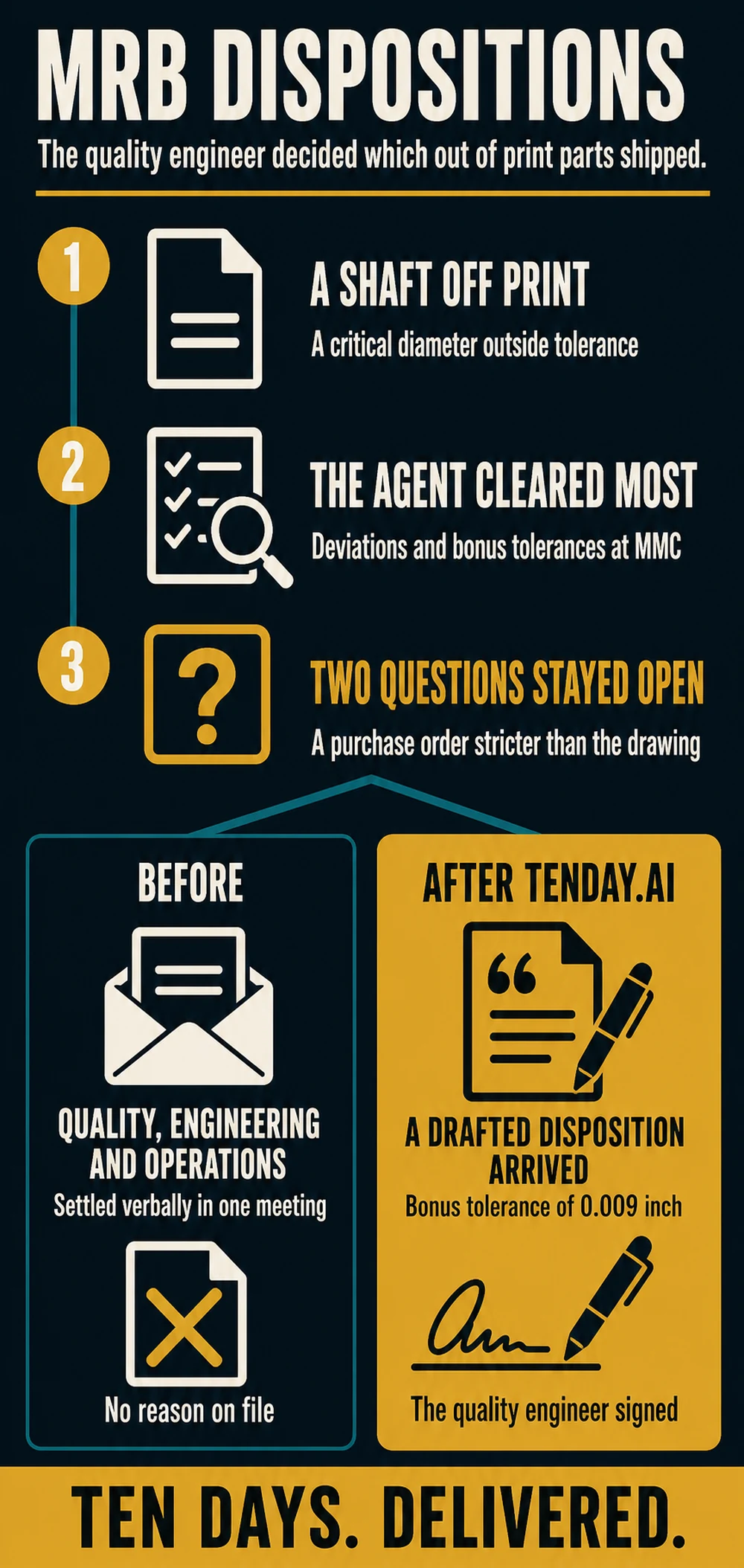
One case, before and after.

three steps, then a fork. one, a shaft off print: a critical diameter outside tolerance. two, the agent cleared most: deviations and bonus tolerances at mmc. three, two questions stayed open: a purchase order stricter than the drawing. before, quality, engineering and operations, settled verbally in one meeting, with no reason on file. after tenday.ai, a drafted disposition arrived, bonus tolerance of 0.009 inch, and the quality engineer signed. ten days, delivered.
The same case, before and after. Tap to view full size.

Honest limits

The case against this build, before anyone commits ten days

Two answers have to come out of a buyer conversation first. Do the drawings and callouts exist as machine readable data, or only as scanned PDFs the agent parses cold? Will the shop's auditor accept a cited, confidence scored recommendation as adequate rationale in the disposition record? Or does that auditor want a different evidentiary format? Either answer changes the build. Neither changes the premise.

This is not an empty field. Tulip already sells an AI defect classifier to exactly this buyer. Today it reads keywords in the defect record. Extend that to compare the measurement against the governing tolerance, and the room this build works in gets small fast.

The vendor descriptions here come from published documentation and product material, not from hands on trials.

Show us the work

More use cases

Two more regulated disposition calls.

Regional hazardous waste treatment, storage and disposal facilities running one to five permitted sites

Waste profile acceptance

A transporter calls Wednesday to confirm a Thursday drop-off. The profile for that stream came back eleven days ago, after a lab reanalysis. It is still sitting behind four others. Approving it correctly means reading five documents at once, against a permit that lives in a different binder.

Read the full write-up

Independent pharmacies and veterinary hospitals, one site or a few, with no in-house compliance department

Significant loss calls

The closing count is short by a bottle's worth of hydrocodone, spread across three weeks of otherwise clean counts. Federal law gives the pharmacist-in-charge one business day from discovery to decide what that is. There is no threshold to look up.

Read the full write-up