Property management

Screening exception calls

Most applicants are an easy yes or an easy no. The ones in between land on a manager's desk, get decided between two other things, and leave no record of why.

Who has itProperty management, 500 to 5,000 units
Whose call it isThe leasing director
BuildTen business days
You keepThe build and its source

The gap

Two criteria answer themselves. Two do not.

Eviction history none on recordClears
Credit floor above the written minimumClears
Income ratio 2.7 times rent against a written 3.0 standardFlagged
Credit file depth thin: 18 months, one revolving accountFlagged
Needs a call.

The report can flag a shortfall. It cannot decide what to do about one. So the file moves by forwarded email to the operations manager, who weighs a thin credit file against a written standard that does not mention thin credit files, and decides. The decision is usually right. It is almost never written down.

Where the tools stop

Every product scores the applicant. None of them will make the call.

That is not an oversight, and each of them says so plainly in its own material. Scoring an applicant is cheap and well solved. Deciding what to do about a borderline one carries fair-housing exposure, and no vendor will take that on for the price of a screening report. The decision is left with the manager on purpose.

RealPage LeasingDesk

Sorts applicants into approved, conditional and denied against a configured criteria matrix. RealPage describes it as decision support rather than a decision-maker.

Yardi RentGrow

The manager sets accept, conditional and decline thresholds. Its consumer disclosures state that it does not make rental decisions and does not set eligibility criteria.

Naborly

Produces a risk rating and hands the property manager a manual approve or deny button. Its support material says the product plays no part in the decision.

AppFolio FolioScreen

Third parties describe an approve-or-deny recommendation. AppFolio's own copy stays careful: the product helps managers make informed decisions.

SafeRent ScorePLUS

The one product that crossed the line, pairing a 200 to 800 score with an accept or decline recommendation. It now sits under a five-year nationwide settlement after Louis v. SafeRent Solutions found the scoring method disadvantaged applicants on prohibited grounds.

What changes

The same applicant, with the reasoning already written down.

The agent reads three things together: the screening report, the application, and the company's own written criteria. It drafts a recommendation, names the criterion it weighed, and says how sure it is. The leasing director signs it, changes it, or throws it out. What is different is that the reasoning exists before anyone asks for it.

Drafted recommendation, awaiting signature

Applicant
Income 2.7 times rent against a 3.0 standard. No evictions. Thin file: 18 months.
Call
Conditional approval, additional deposit of one month's rent
Criterion
Section 4.2, income-ratio shortfall, alternative satisfaction
Confidence 74%
Escalated for sign-off Section 4.2 covers the income shortfall but says nothing about a thin credit file, and that factor can carry disparate impact. Check that the deposit condition is being applied the same way to comparable applicants.

What the engagement needs

A criteria document, read access, and one signature.

The written rental criteria. Read access to the screening reports and applications, by file or by email. Nothing more sensitive than what the screening product already puts in front of staff. The manager who decides today keeps deciding, and stays the only signature on the page.

The whole thing

One borderline applicant, before and after.

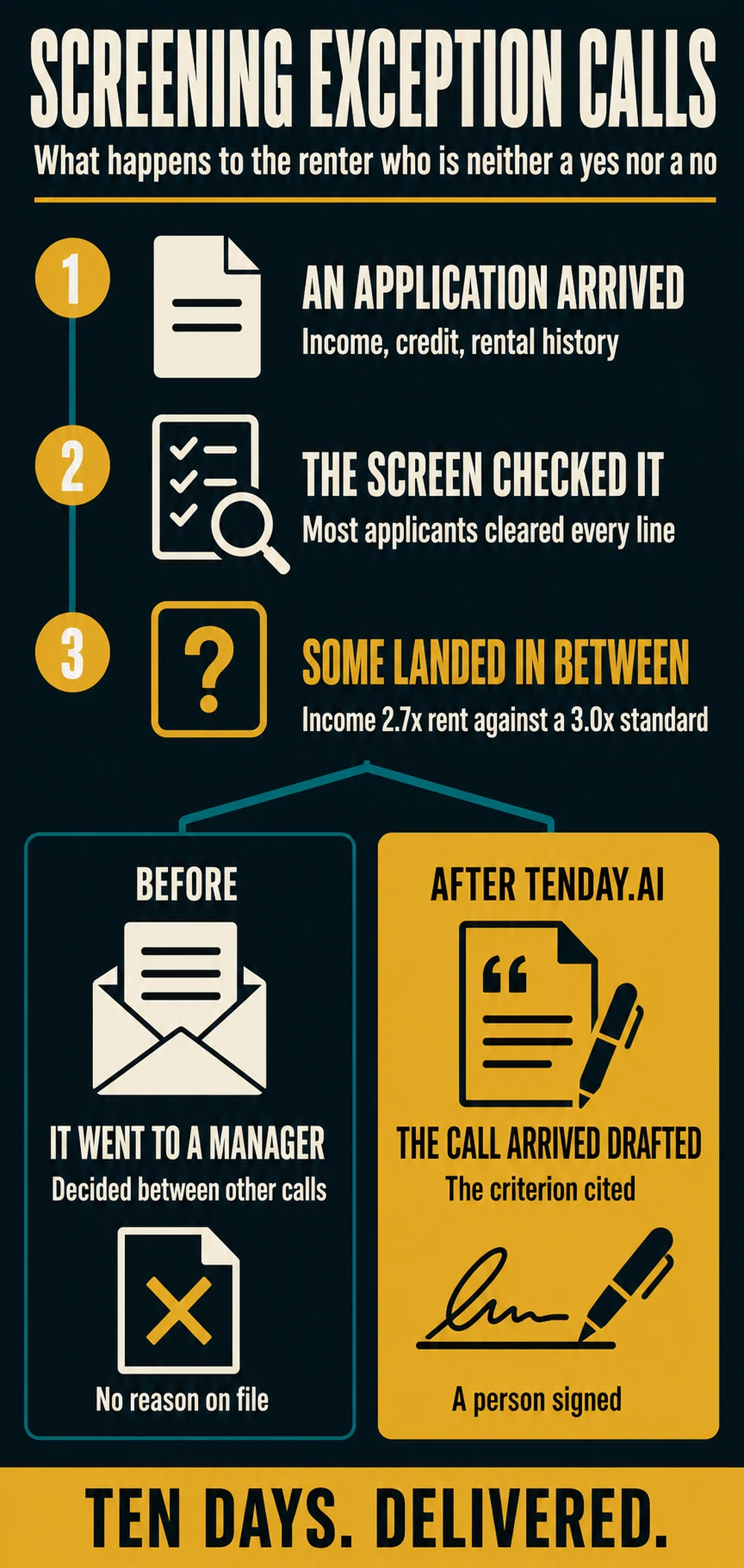
Three steps, then a fork. One, an application arrived with income, credit and rental history. Two, the screen checked it and most applicants cleared every line. Three, some landed in between, with income at 2.7 times rent against a 3.0 standard. The path then splits. Before, it went to a manager, decided between other calls, with no reason on file. After tenday.ai, the call arrived drafted with the criterion cited, and a person signed. Ten days, delivered.
The same exception, before and after. Tap to view full size.

Honest limits

The case against it.

The SafeRent settlement is the first thing a well-read buyer raises, and it deserves a straight answer rather than a slogan. A cited criterion anyone can read is a different thing from a score nobody can inspect, and a person still signs every file. That argument has to be made and won in the room. It is not settled by putting it on a page.

RealPage sits closest. Its configured criteria matrix already holds the rules, and adding a written reason to the output would not be a hard piece of engineering. Anyone already paying RealPage should ask them why it does not, and what it would take.

The vendor descriptions above come from each company's own published material rather than hands-on trials.

Show us the work

More use cases

Two more calls about people and promotions.

US regional beer, wine and spirits suppliers and distributors operating in two to ten states

Preclearance calls

A rep forwards an email thread with a retailer. It carries a proposed display allowance and a file for the point-of-sale sign. Before anyone can say whether it is legal, the compliance director has to reconstruct what was agreed. Three messages, and someone's memory of a phone call.

Read the full write-up

Multi-location employers hiring hourly on repeat: trucking and logistics fleets, multi-unit retail and restaurant franchises, staffing firms

Individualized assessment calls

A background check comes back flagged on a Tuesday afternoon. A hiring manager between shifts decides whether a five-year-old charge bears on a warehouse role. The manager writes two sentences and moves the file.

Read the full write-up