Dealer floor-plan lending

Out-of-trust calls

A field auditor walks a dealer lot on a fixed cycle. The auditor photographs units and checks serials against what the dealer still owes. Most days it is clean. Then a unit is not where the schedule says it should be. The dealer's explanation sounds plausible.

Who has itRegional banks and independent finance companies running dealer floor-plan lines in auto, RV or marine, from a handful of dealers to a few hundred.
Whose call it isThe portfolio risk manager
BuildTen business days
You keepThe build and its source

The gap

Most units on the walk settle themselves. The rest get decided in the lot, by whoever is there that day.

The unit is on the lot Serial checked against the curtailment schedule, photographed, matched.Clears
The payoff landed on time The curtailment payment cleared on or before the date the schedule set for it.Clears
An explanation with no paper behind it At the detail shop, or financing closes Friday, with no sale document on file and the payoff already past due.Flagged
A pattern across the same lot Several units on this dealer's line have run past their dates this cycle, each with a reason that works on its own.Flagged
Needs a call.

The auditor decides on the spot, with a checklist and a phone. Escalate, and spend the dealer relationship on what may be a timing gap. Or write it down and recheck it next cycle. A full cycle is exactly how long a sold-out-of-trust unit can sit unflagged. Either way, the reasoning stays in the auditor's head. Six months later the loss is real, and someone asks why nobody escalated. There is a photo, a checklist, and no record of the judgment.

Where the tools stop

Every product in floor-plan audit tracks the unit. None will render the verdict.

Tracking a unit is a record. Calling one out of trust is an accusation against a dealer. If the call is wrong, it carries the liability. So the software runs the clock, collects the photo, and reports the status. Then it hands the decision back to a person.

NextGear Capital

Logs verification status per unit, collects dealer-submitted photos, and triggers scheduled fees or maturity events when a unit stays unresolved past day 7 or day 15. That is a clock. It does not read the photo and the dealer's explanation and decide whether the gap is credible.

DataScan Onsite

Pairs the platform with an in-house team of human auditors and reports status per unit through Wholesale Intelligence. The software records what a person decided; it does not decide.

AFC

Describes its own audit process in plain language: if there is no reasonable explanation, a unit may be considered sold out of trust. That is stated as a human call, not a system output, which is the most honest description in the category.

CheckVentory / uVerifi

Markets an AI-driven fraud prevention platform using machine learning for portfolio-level anomaly and pattern detection. That is a real claim and the closest thing to a competitor here, though nothing published shows it reasoning across one unit's photos, serial history, dealer statement and payment history to a cited verdict on that unit.

What changes

The same discrepant unit gets its reasoning written down the day the audit turns it up

tenday.ai builds an agent that reads a cycle's audit worksheet and photos. It weighs them against the curtailment schedule and the dealer's prior audit history. For each flagged unit it drafts one of three calls: explainable, needs follow-up, or likely out of trust. Each call carries a confidence score and the evidence it read. Explainable units clear, with the reasoning attached to the file. Everything else queues for the risk manager. The risk manager signs the escalation with the evidence already assembled, not rebuilt from scratch.

Drafted recommendation, awaiting signature

Unit
#4471, 2023 F-150, VIN ending 8842. Flagged missing on the lot walk. Curtailment schedule shows payoff due 14 days ago, unpaid. Dealer statement: sold, financing closing this week.
Call
Likely out of trust.
Criterion
Curtailment aging at 14 days past the scheduled payoff, with no supporting sale document on file.
Confidence 71%
Escalated for sign-off This dealer has twice cleared a financing closing explanation as explainable inside five days. This unit is on day nine with no payoff. The history that made the explanation credible now works against it. The risk manager signs the escalation.
What the engagement needs

The engagement needs the audit file, not a systems project

Audit worksheets and photos, the curtailment schedule, and the dealer's prior audit history. They arrive as files or by email. No regulated data class is involved. The risk manager or portfolio risk manager stays the signature on every escalation. The agent drafts. It never files a claim and never moves against a dealer's line.

The whole thing

One case, before and after.

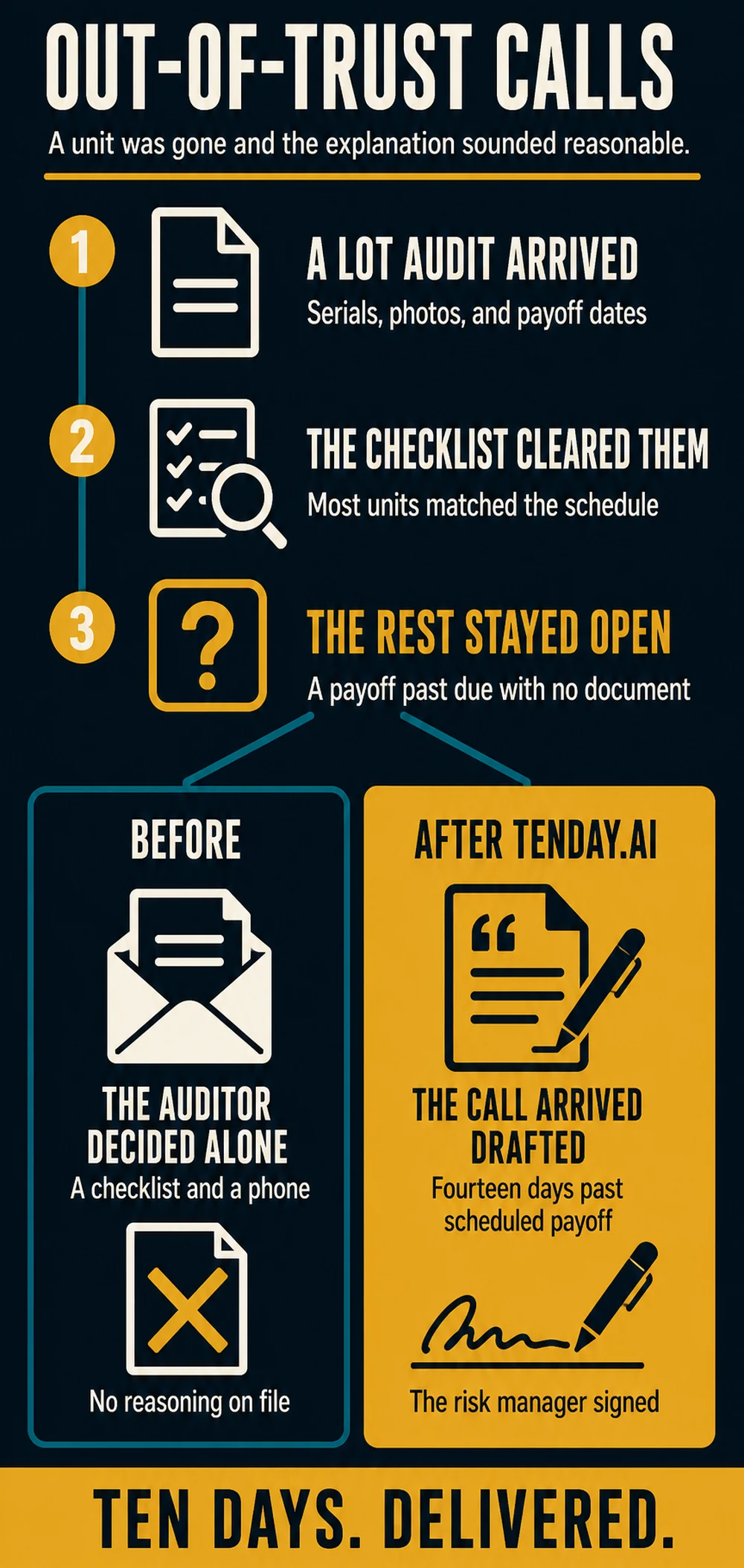
three steps, then a fork. one, a lot audit arrived: serials, photos, and payoff dates. two, the checklist cleared them: most units matched the schedule. three, the rest stayed open: a payoff past due with no document. before, the auditor decided alone, a checklist and a phone, with no reasoning on file. after tenday.ai, the call arrived drafted, fourteen days past scheduled payoff, and the risk manager signed. ten days, delivered.
The same case, before and after. Tap to view full size.

Honest limits

The reasons not to build this are real, and one of them already has a name

This sells hardest in the weeks after a lender eats a sold-out-of-trust loss. That lender wants the next cycle to catch it faster. Without a recent loss in memory, the auditor's judgment call is a cost nobody prices. The build then competes against problems that already have a line item.

CheckVentory / uVerifi already sells AI-driven fraud prevention language to this exact buyer. Nothing public shows it producing a citable, unit-level verdict rather than a portfolio anomaly score. If a buyer conversation shows otherwise, the opening this rests on is narrower than it looks.

The vendor descriptions above come from published material, not hands-on trials.

Show us the work

More use cases

Three more credit and lending calls.

Community banks and credit unions small enough that one or two analysts carry every commercial renewal

Renewal exception calls

A borrower's renewal folder arrives as two years of tax returns, a bookkeeper's statements and a scanned rent roll. No two folders arrive in the same shape. The credit analyst retypes all of it by hand before any credit thinking starts.

Read the full write-up

Mid-size specialty self-directed IRA custodians

FMV sufficiency calls

Three weeks from the Form 5498 deadline, an analyst works down a stack of valuation files. In March it was a trickle. An appraisal, a K-1, a sponsor letter, a purchase agreement nobody has updated in three years.

Read the full write-up

Regional surety and insurance companies writing contract surety bonds

Claim validity calls

A regional downturn does not send one default notice. It sends a run of them inside the same few weeks. Every one waits for an examiner to read the bond. Until then, nobody knows which are fast denies and which are full investigations.

Read the full write-up