Contract surety

Claim validity calls

A regional downturn does not send one default notice. It sends a run of them inside the same few weeks. Every one waits for an examiner to read the bond. Until then, nobody knows which are fast denies and which are full investigations.

Who has itRegional surety and insurance companies writing contract surety bonds
Whose call it isThe claims examiner
BuildTen business days
You keepThe build and its source

The gap

Most of the call is already on the page. The part that decides it is not.

Notice timeliness The bond sets a window for the obligee to file after declaring default. The filing date falls inside it or it does not, and the two documents settle that between them.Clears
Exposure bounds The penal sum and the remaining contract balance cap what this claim can cost. Both are readable off the bond and the last pay application.Clears
Cure notice The contract usually conditions default on a failure to cure after written notice to the contractor. When no cure notice is in the file, nobody can tell from the file whether it was never sent or simply never forwarded.Flagged
Completion percentage The pay applications say one thing and the obligee's notice says another. A gap that wide changes the exposure range and the recommendation with it.Flagged
Needs an examiner.

The reading stops where the paper stops. A missing cure notice and a disputed completion percentage do not resolve on a re-read. The difference between a denial and a resourced investigation sits right there. Until someone reads the file, filing order sets priority. The company learns which claims were fast denies only after the slow ones finish. The obligee does not experience an examiner team stretched past capacity. The obligee experiences a surety gone quiet on a default notice.

Where the tools stop

Every surety platform tracks the claim file. None makes the validity call.

A validity call is a legal judgment that moves a reserve. It turns on how one contract's default provisions read against one completion record. Getting it wrong surfaces as an underfunded reserve or an errors and omissions claim. No vendor wants to own that. Each product stops at the edge of the reading and hands it back to a credentialed examiner. That edge is where the ten-day build starts.

V7 Go

Its surety agent extracts contract terms and flags risk factors during underwriting. The work is pre-issuance only, with no default or claims handling.

SuretyScience Blueprint

Applies decision intelligence to account applications and bond issuance. Also pre-issuance, so a default notice arrives after its work is done.

Tinubu

Runs the claims workflow properly: intake, task assignment, subrogation tracking, deadline dashboards. Its own materials describe surety claims as highly judgment driven, which is the vendor's way of saying the call stays with the examiner.

CLARA Triage

Does severity scoring on claims, and does it well, but for Workers' Comp, Auto and General Liability. Surety is not in its lines.

Inaza

Automates first notice of loss and document analysis for general property and casualty. Nothing surety-specific appears in its published material.

What changes

The same stack of files, read before the formal file opens

The build is one agent. It reads the bond, the underlying contract, and the default notice. It reads the project and completion records and the contractor's prior performance file. Then it drafts one triage call per claim. Not a summary. A call: investigate, request more evidence, or move toward denial. Each call quotes the clause it turns on. Each carries an exposure range bounded by the penal sum and the remaining contract balance. Each also carries a confidence score and the prior record. The examiner reads that instead of the raw stack, decides in minutes, and signs the formal file. Nothing is filed and no reserve is set without that signature.

Drafted recommendation, awaiting signature

Claim
Obligee default notice on a bonded municipal project, filed on day 17 after the obligee declared default under the contract.
Call
Investigate.
Criterion
Bond §4 requires notice of default within 20 days of the obligee's declaration, so the filing is timely. Contract §9.2 conditions default on a failure to cure within 10 days of written notice to the contractor, and no cure notice is present in the file provided.
Confidence 62%
Escalated for sign-off Pay application 14 puts completion at 71 percent. The obligee claims 58 percent. A gap that size moves the exposure range and no paper review closes it. This one goes to the examiner, not toward a denial.
What the engagement needs

The engagement needs the file, not a system of record

The engagement needs the bond, the underlying contract, and the default notice. It needs the project and completion records and the contractor's prior performance file. Whatever mix already sits in shared folders or email will do. No regulated data changes hands. The claims examiner or claims manager reviews every draft. That person remains the only one who opens a formal file or commits investigation resources.

The whole thing

One case, before and after.

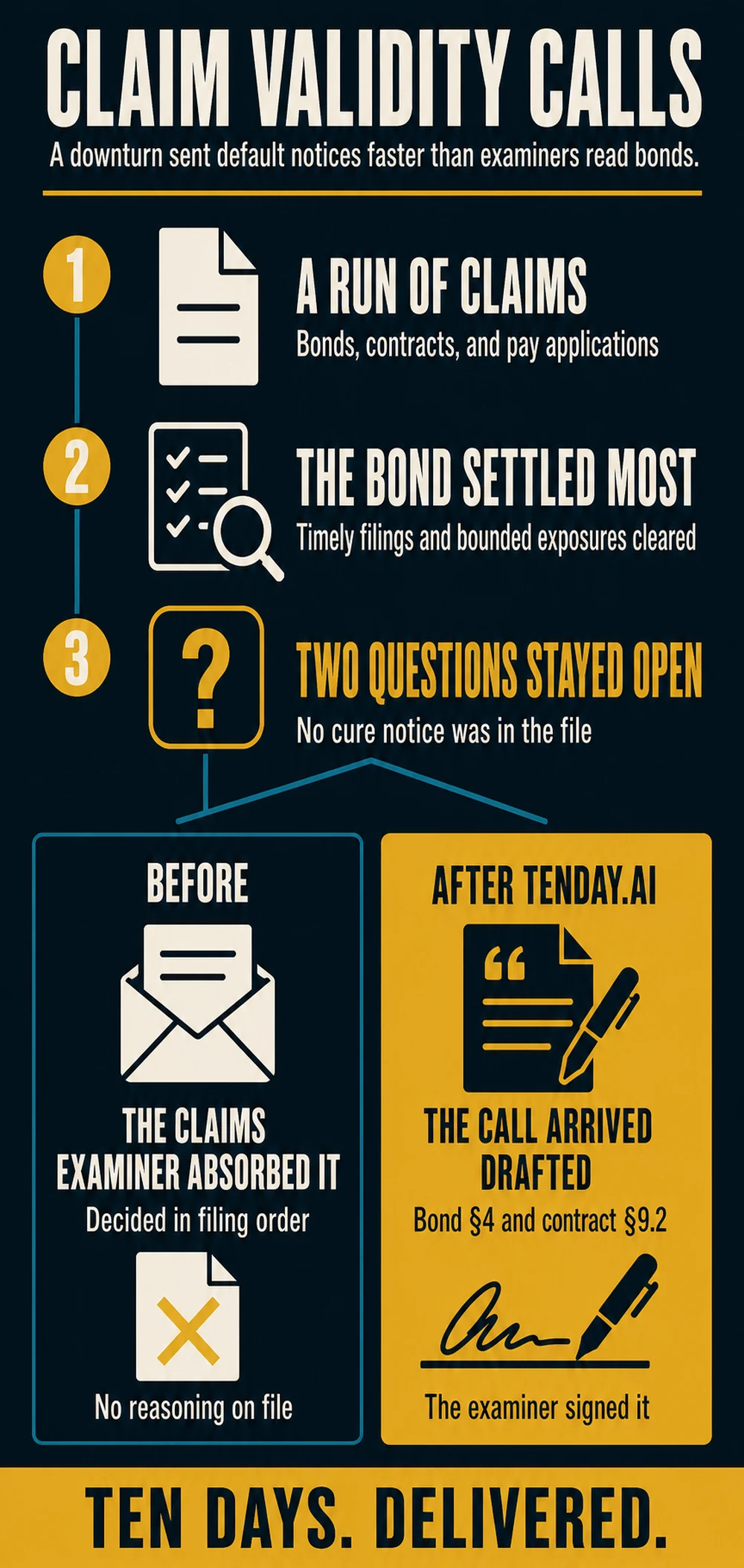
three steps, then a fork. one, a run of claims: bonds, contracts, and pay applications. two, the bond settled most: timely filings and bounded exposures cleared. three, two questions stayed open: no cure notice was in the file. before, the claims examiner absorbed it, decided in filing order, with no reasoning on file. after tenday.ai, the call arrived drafted, bond §4 and contract §9.2, and the examiner signed it. ten days, delivered.
The same case, before and after. Tap to view full size.

Honest limits

The case against this build, before anyone builds it

One question decides the rest. Will a claims manager let a drafted judgment sit inside a claim file at all? It would be unsigned and clearly advisory, but the call touches reserve setting and errors and omissions exposure directly. If the answer is no under any condition, the build has nowhere to land. Two softer limits sit behind it. A first read is only as good as the file behind it. A book whose default notices, contracts and prior-performance records are not already digital and centrally reachable has a different problem. Those ten days go to document assembly instead of the model. And this gets bought under pressure, during a spike that is outpacing the team. In a steady month, the cost of a manual read does not feel urgent enough to act on.

Tinubu is the competitor closest to closing this gap. It already owns the claims workflow and the examiner relationship. Putting a drafted call on top of intake is a product decision for Tinubu, not a market entry. That is not true for a Workers' Comp specialist like CLARA.

These vendor descriptions come from published product material and public write-ups. No hands-on trials. The sweep also turned up general claims-adjudication vendors: Riskonnect, Decerto and Sprout.ai among them. Nothing confirms that they handle surety. They are worth a second look before a buyer conversation. They are not ruled out.

Show us the work

More use cases

Three more credit and lending calls.

Community banks and credit unions small enough that one or two analysts carry every commercial renewal

Renewal exception calls

A borrower's renewal folder arrives as two years of tax returns, a bookkeeper's statements and a scanned rent roll. No two folders arrive in the same shape. The credit analyst retypes all of it by hand before any credit thinking starts.

Read the full write-up

Mid-size specialty self-directed IRA custodians

FMV sufficiency calls

Three weeks from the Form 5498 deadline, an analyst works down a stack of valuation files. In March it was a trickle. An appraisal, a K-1, a sponsor letter, a purchase agreement nobody has updated in three years.

Read the full write-up

Regional banks and independent finance companies running dealer floor-plan lines in auto, RV or marine, from a handful of dealers to a few hundred.

Out-of-trust calls

A field auditor walks a dealer lot on a fixed cycle. The auditor photographs units and checks serials against what the dealer still owes. Most days it is clean. Then a unit is not where the schedule says it should be. The dealer's explanation sounds plausible.

Read the full write-up