From a request a business posted
Bank and card transactions matched to the books
The bookkeeper codes every bank and card line by hand, then chases the owner about the charges nobody explained.
Freight and hauling
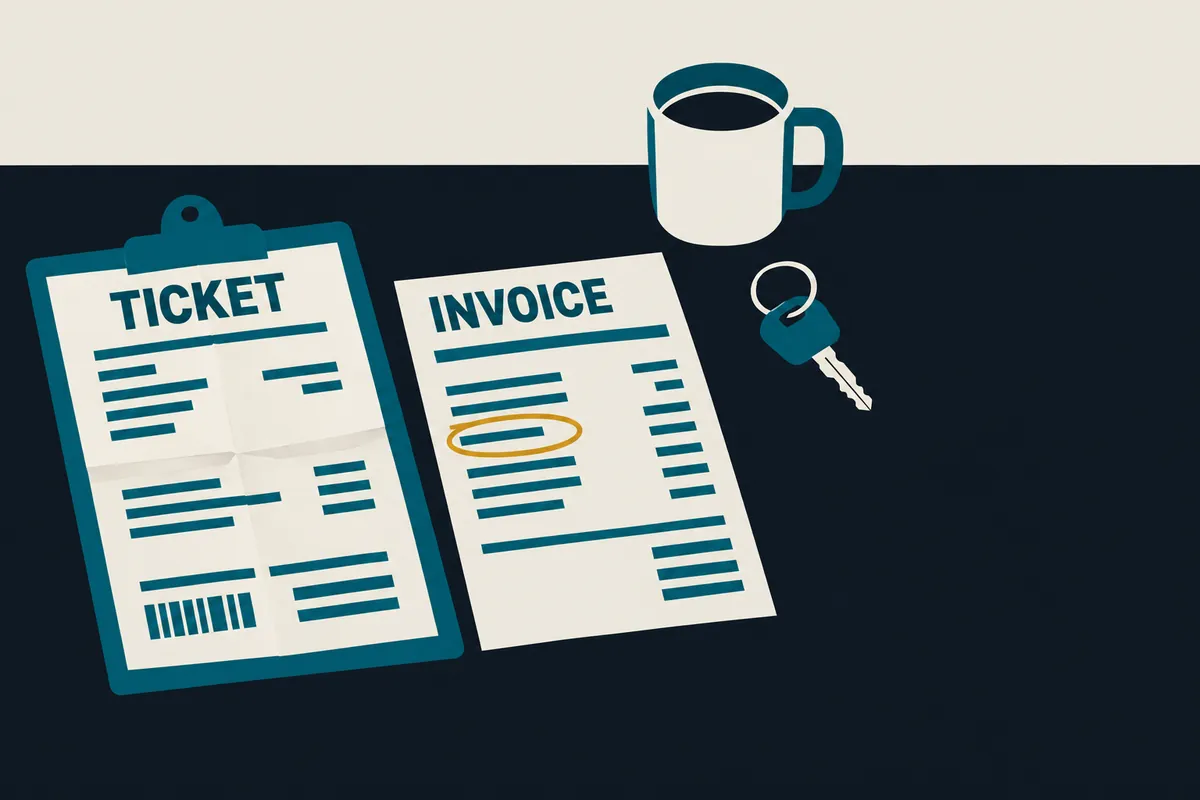
The billing coordinator at a carrier, hauler or 3PL matches proof-of-delivery documents and tickets against orders and invoices, and that paperwork arrives as phone photos, scanned paper notes, emails and chat messages. At month-end the team still finds short shipments nobody billed and customers disputing invoices because a POD is missing or does not agree.
Who does what
What you get
Draft for review
The rules it follows
These are your company's own rules, written down and confirmed with your team during the build. It works on its own only within limits you set.
What it learns when your team adjusts its work
The busywork it takes off the billing coordinator. It takes over the matching of tickets and PODs to loads and invoice lines that the billing coordinator does by hand at month-end. That time goes back to the work only they can do.
What it starts out knowing
It works from these sources, shows which one an answer came from, and asks when the answer is not there.
Who reviews its work, and when review can stop
At first the billing coordinator reviews every match before an invoice goes out. Once the agent's record on a routine type, such as clean signed tickets for a regular customer, is good and the business agrees, review stops for that type.
Disputes, missing PODs, unbilled detention and any charge outside a customer's terms keep going to a person.
It no longer needs review once its record on them is good and you agree, one type of task at a time. New, unusual and high-stakes work stays with a person.
When your team adjusts its work
When the billing coordinator accepts a 0.4 ton difference on one customer's tickets because that customer's scale reads light, the change is saved as an exception for that customer, and next time the agent passes differences within that range and still flags anything larger. The team decides which changes become rules.
It learns how your company does this job. It does not watch, rate or profile your employees. Your team decides what it learns. You can read everything it has learned and remove anything. Whoever runs it, your team or our engineers, makes sure on a regular cycle that what it learned stays inside the bounds you agreed.
From a request a business posted
Delivery confirmations come in as photos, scanned paper, emails and chat messages, and someone has to match each one to its purchase order before billing the customer. The month-end reconciliation keeps turning up short shipments that never got billed and invoices customers push back on because the paperwork is missing or inconsistent.
Paraphrased from a public post, not quoted, and not a client engagement.
From first principles
Before we build anything, we take the work down to what has to be true. What is left over is habit. Habit gets deleted, not automated.
What has to be true
What is only habit
Waiting until month-end to match everything at once is only habit. So is calling drivers to read numbers off a ticket that is already sitting in a text thread.
What we delete before building anything
We drop the month-end batch and the second copy of tickets typed into a spreadsheet. Each document gets matched the day it arrives.
What is left
The agent. The agent collects each ticket and POD from texts, email and photos, reads the load, weight and signature, matches it to the load and the invoice line, and lists every mismatch before billing.
A person. The billing coordinator decides every mismatch, dispute and extra charge before it reaches a customer.
The kind of work: Checking and matching. Checking and matching is the work of holding one record against another: a bank line against the books, a delivery ticket against an invoice, a payout against the sales behind it, a customer's request against the price list. People still do it by hand because the records never line up exactly, and someone has to decide what each mismatch means.
What the engagement needs
We need read access to the inbox or text line where drivers and partners send tickets and PODs, and to the TMS or dispatch sheet where loads are logged. We need access to draft invoices in QuickBooks or the billing system, plus each customer's price list and terms.
We check the time this job takes, access to your systems and how you would review the result. If a ready-made tool is enough, we say so.
Senior engineers agree the rules with the billing coordinator, test on past cases and set approval limits and a way to switch it off.
Work with the agent in Slack, Teams or text messages. We fix problems and adjust it as unusual cases come up.
You own the agent and keep its source, tests and guide either way. Your team runs it, or our engineers run it with a monthly report. Learning continues on your own servers, in your own cloud account or in our data center.
When we'd point you elsewhere
The fit test checks this first. If one of these covers your case, we tell you, and you keep the map of the work.
Honest limits
The agent can only read what the paperwork shows. A lost or unreadable ticket still needs a driver or customer to send a new one.
The situation on this page is drawn from a public request a business posted, paraphrased, not a client engagement.
More use cases
From a request a business posted
The bookkeeper codes every bank and card line by hand, then chases the owner about the charges nobody explained.
From a request a business posted
Bookkeepers spend hours in spreadsheets breaking each Shopify, Amazon, PayPal and Square payout into sales, fees and refunds.
From a request a business posted
Re-typing every line of a customer's PDF request, hunting each part in the catalog, then looking up the approved price.